
For many jobseekers, one of the most frustrating parts of looking for work is seeing an "entry-level" position that still asks for one, two, or even three years of experience. So what does "entry-level" actually mean in Singapore? New data from the Ministry of Manpower provides an interesting answ...
Read More
When people think about manufacturing, they may still imagine factory floors, repetitive manual work, and traditional production lines. But Singapore's manufacturing industry is changing rapidly. Today, factories are becoming more automated, connected, and technology-driven. Workers are increasing...
Read More
For decades, Singapore's workforce has often placed a strong emphasis on academic qualifications and white-collar careers. But that mindset may be changing. A recent Business Times feature highlighted a growing interest among some younger Singaporeans in blue-collar and technical careers — c...
Read More
For years, one question has dominated conversations about artificial intelligence: Will AI take our jobs? Singapore's latest research provides a more complicated — and potentially more encouraging — answer. A new study published by Singapore's Ministry of Trade and Industry (MTI)...
Read More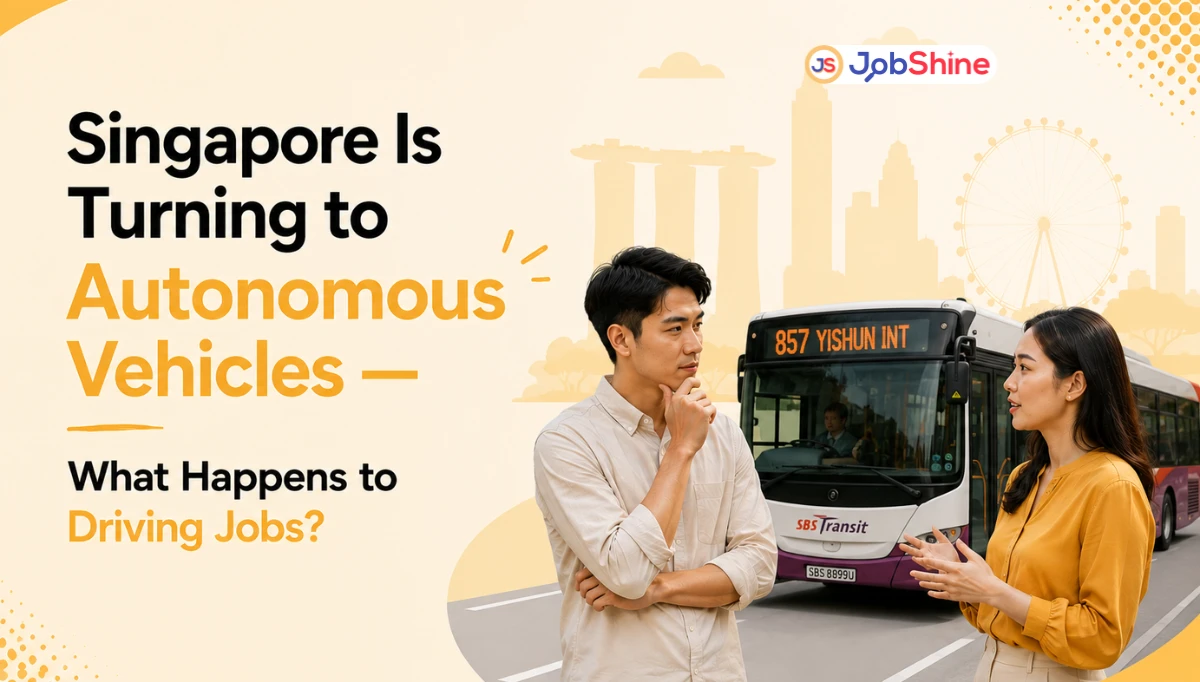
Singapore is preparing for a major change in the way people and goods move around the city. At the 2026 National Day Rally, Prime Minister Lawrence Wong said Singapore intends to gradually scale up autonomous vehicles once the technology is proven safe and reliable. The move is partly driven by a p...
Read More
Singapore's labour market has an interesting problem. There are still many job vacancies — yet some groups of jobseekers continue to struggle to find suitable employment. Data from Q1 2026 showed 73,300 job vacancies, while unemployment among residents aged below 30 reached 6.2%. This sugges...
Read More
Artificial intelligence has become one of the biggest conversations in the world of work. Many workers worry that AI will eventually replace their jobs. But current evidence suggests a more complicated picture: AI is changing jobs, rather than simply eliminating them. Recent research and labour-ma...
Read More
Singapore's labour market is sending mixed signals in 2026. On one hand, retrenchments increased to 4,500 workers in Q2 2026 — the highest quarterly level in more than five years. On the other hand, employment continued to grow, with 10,700 new jobs added during the same quarter. So, what...
Read More
Behind every successful business is a workforce that keeps daily operations running — blue-collar workers. From warehouse assistants and delivery drivers to cleaners, kitchen staff, machine operators, and technicians, blue-collar employees play a critical role in supporting Singapore's econom...
Read More
For years, every new generation entering the workforce has been labelled as "less hardworking" than the one before. Millennials were once criticised for changing jobs too often. Before them, Generation X was called the "slacker generation." Today, Gen Z faces similar stereotypes — being descr...
Read More
