
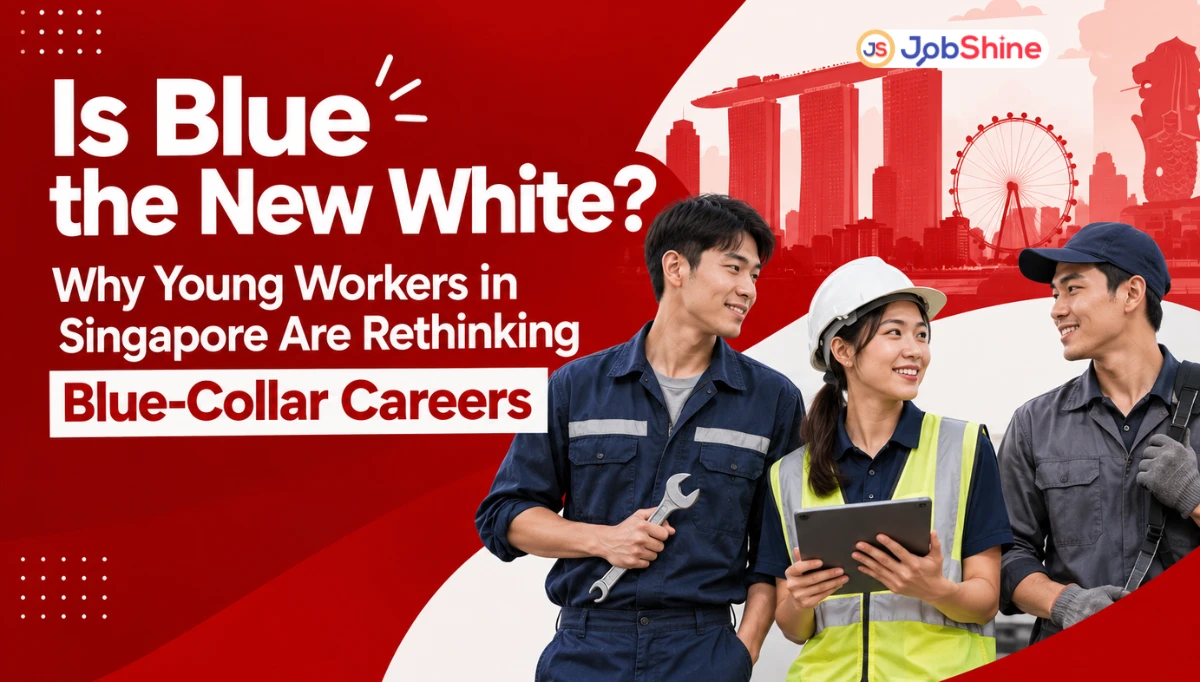
For decades, Singapore's workforce has often placed a strong emphasis on academic qualifications and white-collar careers.
But that mindset may be changing.
A recent Business Times feature highlighted a growing interest among some younger Singaporeans in blue-collar and technical careers — challenging the traditional perception that success must mean getting an office job.
The question is no longer simply: "Why don't young people want blue-collar jobs?"
It may be:
"What if blue-collar careers are becoming more attractive?"
Technical workers such as technicians, mechanics, electricians, and skilled tradespeople perform jobs that cannot simply be moved online.
As Singapore's economy becomes more technology-driven, these roles can become increasingly important:
Technology doesn't eliminate the need for practical skills. In some cases, it makes those skills more valuable.
The more automated Singapore becomes, the more it needs people who can operate, maintain, and work alongside that automation.
One challenge remains: perception.
Blue-collar work has traditionally been associated with physically demanding jobs and lower social status. But for some young workers, the calculation is changing.
A technical career can offer:
The traditional distinction between "manual work" and "skilled work" is becoming less useful.
A technician operating sophisticated equipment isn't simply performing manual labour — they are applying technical knowledge in a physical environment.
Ironically, technology may help change perceptions of blue-collar work.
Modern factories, warehouses, and facilities increasingly rely on automation, digital systems, sensors, robotics, and data. This means today's blue-collar worker may need a very different skill set from the worker of 20 years ago.
The role can involve both hands-on work and technology — a combination that could create new career pathways for workers who prefer practical problem-solving over traditional office-based work.
Blue-collar work today isn't what it was a generation ago. And that difference is exactly what makes it worth a second look.
If companies want to attract younger workers, changing the job title alone isn't enough.
Employers need to communicate what the career can actually become.
Instead of presenting a role as simply "Warehouse Worker" — employers could show the potential pathway:
Warehouse Worker → Equipment Specialist → Team Leader → Operations Supervisor
Career progression can make operational jobs more attractive to younger candidates. Workers are more likely to consider a role when they can see how today's position contributes to tomorrow's career.
The best recruitment pitch isn't a better job ad. It's a visible career path.
This shift also creates an opportunity for employers to rethink hiring criteria.
Instead of requiring years of experience, employers can look for:
A candidate without extensive experience may still become an excellent technician or operations specialist — if the company provides the right training.
The best hire isn't always the most experienced one. It's often the one most willing to grow.
Singapore faces an ongoing challenge: maintaining a productive workforce despite demographic and manpower pressures.
The recent discussion around autonomous vehicles, ageing taxi drivers, and difficulty recruiting bus captains is one example of the broader challenge.
At the same time, industries need workers who can operate increasingly sophisticated systems — creating an opportunity to rethink what a successful career looks like.
Not every worker needs to sit behind a desk. Some of the most valuable careers happen on the factory floor, in a warehouse, on the road, or inside a building's operations team.
The future workforce will need software engineers and accountants. But it will also need technicians, mechanics, operators, logistics workers, maintenance specialists, and skilled tradespeople.
The distinction between blue-collar and white-collar work is becoming less important than the skills, technology, and value a worker brings to the business.
For employers, that means the opportunity is not simply to find more workers — it is to help the next generation see blue-collar careers as skilled, modern, and worth building a future in.
The companies that recognise this shift early won't just fill today's vacancies — they'll build the skilled workforce Singapore needs tomorrow.
Partner with Jobshine to build a stronger, more stable team: www.jobshine.sg
#BlueCollar #BlueCollarWorkers #SkilledWorkers #SingaporeJobs #SingaporeRecruitment #Hiring #Recruitment #TalentAcquisition #Workforce #Employment #CareerOpportunities #SkillsBasedHiring #HumanResources #HR #HiringStrategy #LogisticsJobs #ManufacturingJobs #FNBJobs #JobShine

