
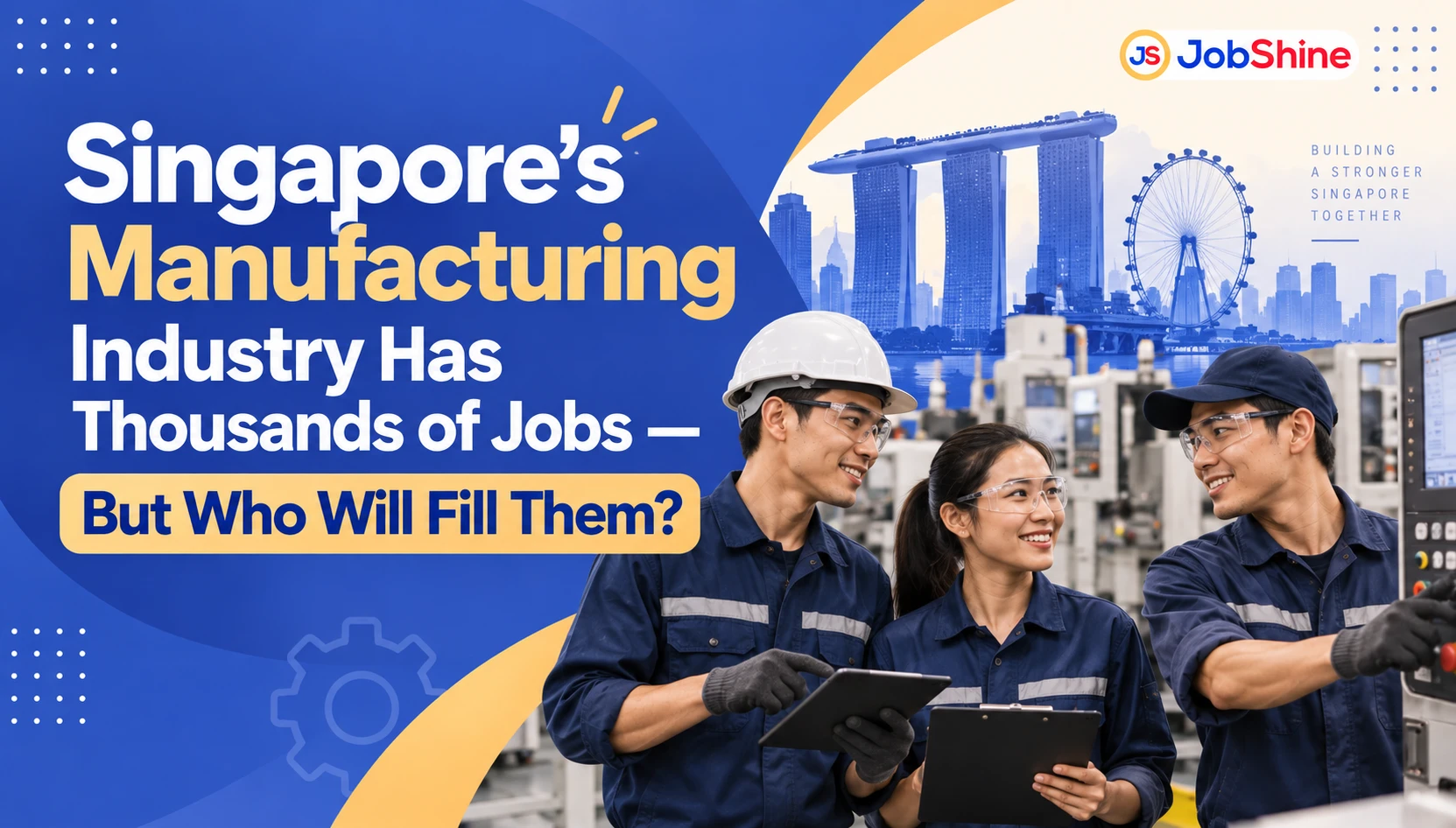
When people think about manufacturing, they may still imagine factory floors, repetitive manual work, and traditional production lines.
But Singapore's manufacturing industry is changing rapidly.
Today, factories are becoming more automated, connected, and technology-driven. Workers are increasingly expected to operate sophisticated equipment, understand digital systems, and solve technical problems.
And despite this transformation, one challenge remains:
Singapore's manufacturers still need people — and finding them is getting harder.
The image of a manufacturing worker standing on a production line all day is becoming outdated.
Modern manufacturing increasingly involves:
This means today's manufacturing workforce needs a combination of practical skills and technical knowledge.
Modern manufacturing isn't just physical work — it's technical work in a physical environment.
One of the industry's biggest challenges is perception.
Manufacturing can still be viewed as a traditional or less attractive career compared with office-based professions. But that perception doesn't necessarily reflect the reality of today's jobs.
A modern manufacturing role can involve engineering, technology, problem-solving, equipment management, and specialised technical skills — creating career opportunities that are very different from the traditional image of factory work.
The gap isn't between the jobs and the workers. It's between what people think the jobs are — and what they actually are.
As manufacturing becomes more sophisticated, employers need workers who can learn.
The most valuable candidate may not always be the person with the longest manufacturing experience. It could be someone who demonstrates:
This creates opportunities for workers who may not have a traditional manufacturing background — but have the right mindset to grow into one.
A manufacturing career does not have to remain at entry level.
With training and experience, workers can potentially progress into roles such as:
Production Operator → Senior Operator → Technician → Specialist → Supervisor
This career progression is important because it changes the way workers should view operational jobs.
A job can be the starting point of a career — not simply a temporary position.
Manufacturers that want to attract more workers need to rethink how they present their jobs.
Instead of simply advertising "Factory Worker Needed" — employers can explain:
Young workers are more likely to consider an opportunity when they can see where it can lead.
Employers should also consider widening their candidate pool — rather than focusing only on candidates with previous manufacturing experience.
The right training can bridge the remaining gap.
The best manufacturing hire may be someone who has never worked in a factory — but is ready to learn everything about it.
For employers, finding candidates with the right combination of skills, experience, and willingness to learn can be challenging.
Jobshine helps businesses connect with candidates across operational and blue-collar roles — making it easier to reach workers who are looking for their next opportunity.
For jobseekers, the platform provides access to roles where practical skills and potential matter — not just academic qualifications.
Singapore's manufacturing industry is changing. The jobs are changing. And the workers needed for those jobs are changing too.
The biggest opportunity may be to stop thinking of manufacturing as an industry of "factory jobs" — and start seeing it as an industry of technology, skills, and career opportunities.
The jobs are there. The challenge is finding the people who are ready to fill them — and helping them see why it's worth it.
Partner with Jobshine to build a stronger, more stable team: www.jobshine.sg
#Manufacturing #ManufacturingJobs #BlueCollar #SkilledWorkers #SingaporeJobs #SingaporeRecruitment #Hiring #Recruitment #TalentAcquisition #Workforce #Skills #HumanResources #HR #HiringStrategy #JobShine

