
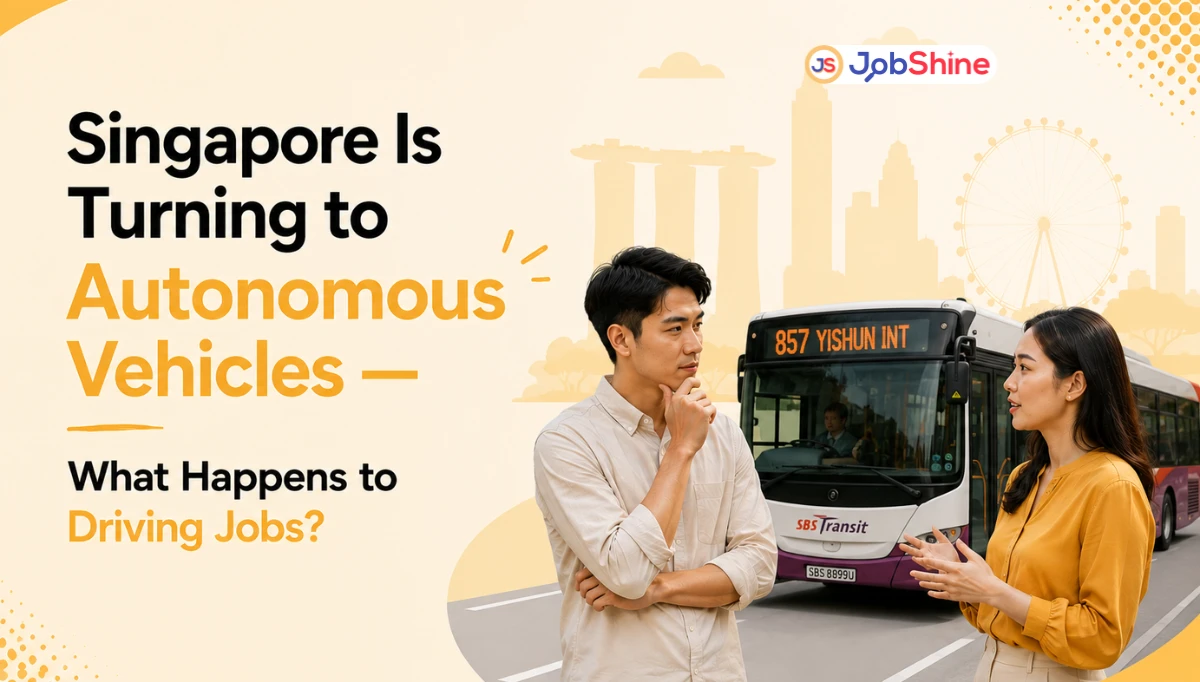
Singapore is preparing for a major change in the way people and goods move around the city.
At the 2026 National Day Rally, Prime Minister Lawrence Wong said Singapore intends to gradually scale up autonomous vehicles once the technology is proven safe and reliable. The move is partly driven by a practical problem: Singapore is finding it increasingly difficult to recruit bus captains, while two in three taxi drivers are already aged 60 and above.
But this creates an important question:
What happens to workers whose jobs depend on driving?
Autonomous vehicles could help Singapore address manpower shortages in transportation. With fewer available drivers and an ageing workforce, autonomous technology could help maintain reliable transport services without relying entirely on a growing supply of human drivers.
But for existing drivers, the transition creates uncertainty.
A technology that solves a labour shortage can also disrupt the careers of workers currently filling those roles.
That is why Singapore's approach is not simply to introduce autonomous vehicles as quickly as possible. The government has said the rollout will be progressive, with retraining and support for affected drivers.
The goal isn't disruption — it's a managed transition. But workers still need to prepare.
The transition doesn't necessarily mean that experienced drivers have no future.
Instead, their experience could become transferable to other roles. Workers with years of experience in transportation may have valuable skills in:
The job title may change — but the experience doesn't have to become irrelevant.
The same pattern could happen across other industries:
In each case, technology may reduce the need for certain tasks while increasing demand for workers who can operate, supervise, maintain, or work alongside the technology.
Automation isn't arriving in one industry. It's arriving everywhere — at different speeds.
The biggest challenge may not be whether technology replaces jobs.
It may be whether workers have enough opportunities to transition into the jobs that technology creates.
This is particularly important for blue-collar workers. A worker who is willing to learn new equipment, digital systems, or operational processes may have far more options than someone whose experience is limited to one specific task.
For employers, this also changes the way recruitment should work — hiring people with transferable skills and a willingness to learn, not just those who have done the exact same job before.
The most valuable worker tomorrow may not be the most experienced one today — it may be the most adaptable one.
As automation expands, employers can prepare by:
1. Identifying transferable skills
Understand which existing employees could move into new roles as technology changes job requirements.
2. Investing in training
Technology adoption works better when workers know how to use it. Training isn't optional — it's part of the transition.
3. Hiring for adaptability
A candidate who learns quickly may be more valuable than one with experience that is becoming outdated.
4. Redesigning jobs
Automation doesn't always mean eliminating a role. Some jobs can be redesigned so technology handles repetitive tasks while workers focus on areas requiring judgement and human interaction.
Singapore's autonomous vehicle push is not simply a story about driverless cars.
It is a preview of a much bigger transformation in the workforce.
As technology takes over some tasks, workers will need opportunities to move into new ones. And for employers, the competitive advantage may come from building a workforce that can adapt as quickly as technology changes.
The future belongs to those who prepare for it — not those who wait to see what happens.
Partner with Jobshine to build a stronger, more stable team: www.jobshine.sg
#AutonomousVehicles #FutureOfWork #BlueCollar #BlueCollarWorkers #TransportJobs #SingaporeJobs #SingaporeRecruitment #Workforce #Skills #Upskilling #Reskilling #Hiring #Recruitment #TalentAcquisition #HR #HumanResources #JobShine

